-
-
- Financial Aid
- Financial Aid
- Scholarships
- Loans
- Grants
- Federal Work Study
- Additional Resources
-

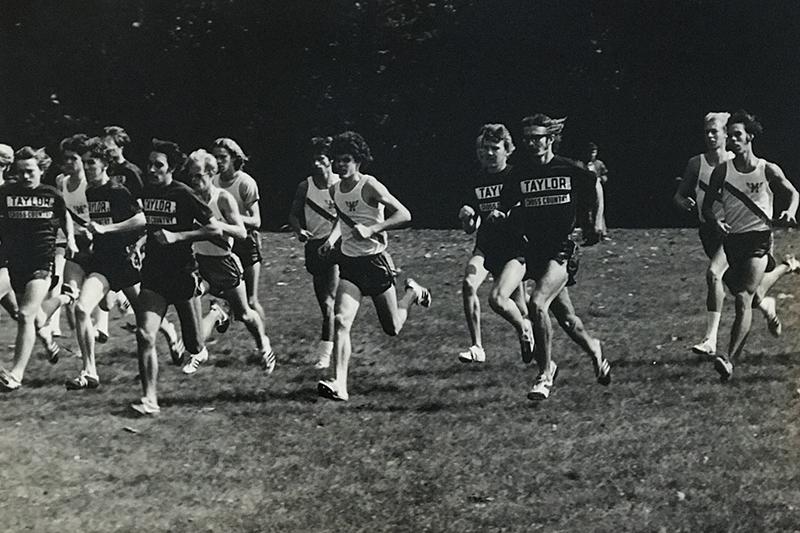
In the 1970s, I arrived at Taylor University with two dreams: to get an art degree and to become one of the greatest runners in the history of the cross-country program. However, what I discovered in Upland was something far greater. I became a part of a community that shaped me emotionally and spiritually and gave me friendships that have endured for decades. Taylor wasn’t an obvious choice for me in the beginning. I was a mediocre student in a struggling school district outside Philadelphia. I came from a broken home where education was not emphasized, and I came to believe that my performance in sports was the only thing that determined my worth. I could never seem to please my father, no matter how hard I tried. The only things I knew I was good at were drawing and running, but for many years I had no one encouraging me or affirming my gifts. In many ways, I was alone. Even so, running became my identity. My high school coach believed in a "blood and guts" philosophy of running—the idea that the more pain and punishment we endured, the better runners we would become. By my senior year, I was setting school records, but I was still searching for something more.
The early 1970s was the beginning of America’s running boom. Inspired by athletes like Frank Shorter and Steve Prefontaine, I dreamed of competing at the highest level. Though my grandfather, a Methodist minister who passed away before I was born, established a trust that would provide financial support for me if I attended Taylor, I wasn’t sure if this was the path I wanted to take. Surely a small Christian college in the middle of Indiana cornfields would not have a serious running program. Then one day in 1972, I was sitting in a barbershop when I came across an article in Sports Illustrated about Ralph Foote, who had won the NAIA national cross-country championship a few years earlier.
And there it was: "Taylor University in Upland, Indiana."
I stared at those words—that had truly fallen into my lap—until the barber called my name.
It seemed like a sign, so after my haircut, I went home and wrote a letter (yes, an old-fashioned letter with an 8-cent postage stamp) to Coach George Glass. I told him about my two-mile record and the trust fund. I also didn’t shy away from sharing my intention to become the greatest runner in Taylor’s history.
Coach Glass responded with enthusiasm. I was shocked. No one had ever been that encouraging about my dreams before. He did not laugh at me or dismiss my ambition. Instead, he welcomed the challenge, and suddenly, I was Taylor-bound.
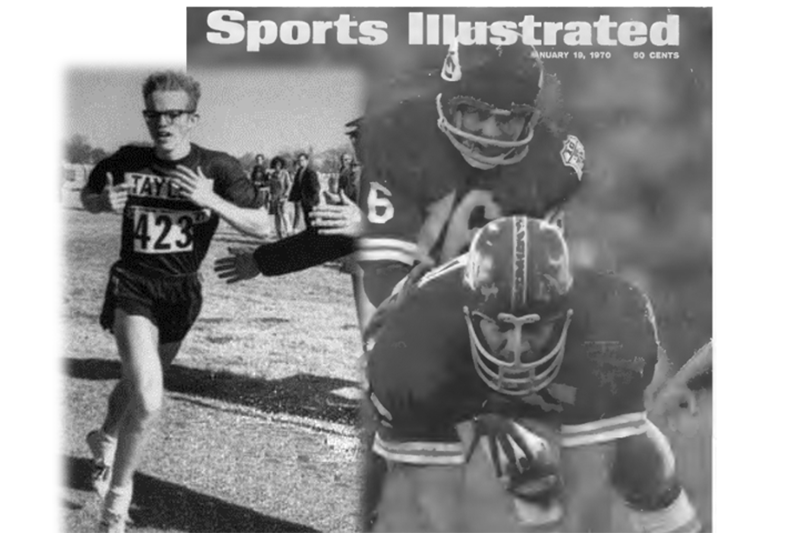
A segment of Sports Illustrated mentioned Ralph Foote's win in the 1969 NAIA national cross-country championships.
On my first day at Taylor, I joined the cross-country team for a morning workout after the runners had returned from one of Coach Glass’s famous training camps—referred to as "Miracle Camps"— where the team had spent the week completing grueling workouts. The team captain was Taylor Oliver. I had no idea who he was, and I didn’t care. To me, he was just another runner I needed to beat.
The workout started slowly, and I assumed we were just warming up. When the group did not speed up, I became impatient. I moved slightly ahead to test the pace.
"Get back here, freshman!" Taylor shouted. "This is an easy workout. Wait for the hard one later." The slow pace was agonizing and just felt like a waste of time to me. I took off at my normal race pace, leaving the team behind me. Taylor simply turned to teammate Brad Shrock and said, "I’ll take care of this guy."
Taylor left the group and settled right behind me. I tried everything I could to pull away, but he stayed right on my tail, making it look easy. I could see the Taylor University water tower in the distance and told myself that if I could just make it there, I could use my legendary kick to beat him back to campus.
The only problem? Taylor Oliver actually had a legendary kick.
He beat me—badly.
That first run began a lifelong lesson in humility. I learned that success was not just about individual talent. It was about becoming part of something bigger. Little did I know I still had miles to go before those lessons started to sink in.
I made the varsity team, where I quickly learned that I had plenty of room to grow as both an athlete and a person. Taylor was becoming more than a college experience. It was becoming home. In my growth journey, Coach Glass became a father figure to me, and through his leadership, discipline, and encouragement, my old conviction that my worth was found in my achievements slowly began to unravel. I did not have to earn love by winning races or being successful. There was love being offered to me freely. I began to see the difference Christ made in the lives of Coach Glass and my teammates, and at the end of my sophomore year, I knelt beside my bed in Wengatz Hall and prayed for Christ to enter my life.
During my junior year, my teammates elected me as captain. I was honored by their confidence, but I still had a long way to go to learn how to be a good leader. Even though I was growing in Christ, that streak of competitive pride still showed up in my life. My greatest goal that year was defeating Steve Gradeless, but he had the audacity to run faster than me in every race. We didn’t win the conference championship that year, but Steve qualified for the national cross-country meet and earned the first of his two All-American honors. I’ll admit it wasn’t always easy to celebrate with him. I had to learn that leadership was not about proving I was the best runner. It was about serving my teammates, just as Christ had served me.
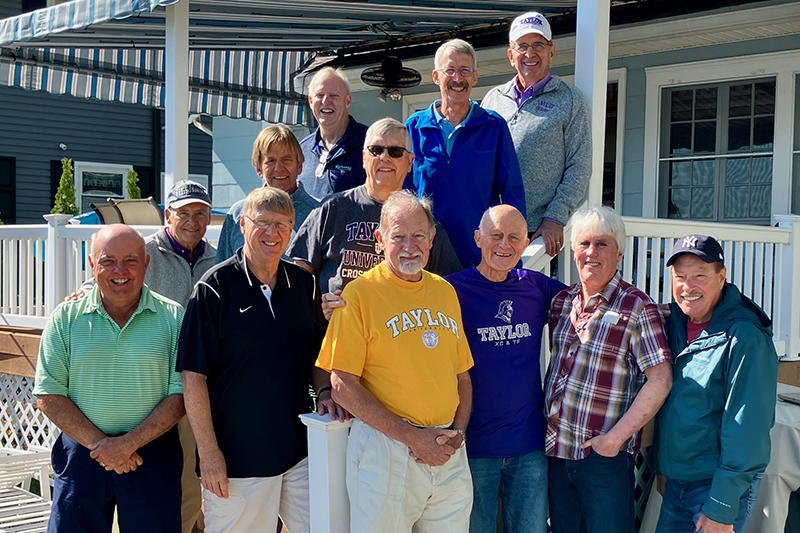
Ground Level L-R: Randy Moore, Randy Crist, Steve Gradeless, George Glass (Coach), David Lewis, Tim Reusser. Back Steps L-R: Al Feeley, Doug Taylor, Rick Haynes, Taylor Oliver, Brad Shrock
Flash forward, decades later, I reconnected with Steve Gradeless at an alumni event. He invited me to his home and showed me one of my old paintings hanging in his office.
He told me he had rescued it from a dumpster years earlier after I had thrown it away. After I had had such a hard time celebrating him, he had picked through garbage to celebrate my work. I apologized for being so focused on beating him instead of being the teammate and leader I should have been. That conversation led to an idea: a reunion of our cross-country teams from the 1970s. What started as a simple gathering grew into an annual tradition that has continued for 15 years. Around 25 members of Taylor’s running teams from that era have attended over the years, including Coach Glass and Taylor Oliver.
Fifty years later, the friendships remain.
Fifty years later, Coach Glass’s lesson remains as well: our identity is not found in our accomplishments, but in who we are becoming in Christ.
Today, Taylor’s cross-country tradition of excellence continues. The women’s team captured the 2025 NAIA National Championship, while the men’s team finished fifth nationally. More important than any award or championship is Coach Glass’s legacy of excellence, faith, and community that Taylor runners still model today. These are traits that defined Taylor’s cross-country program in the 1970s, and they’re traits that are continuing to help generations of Taylor athletes run with endurance the race set before them.