-
-
- Financial Aid
- Financial Aid
- Scholarships
- Loans
- Grants
- Federal Work Study
- Additional Resources
-

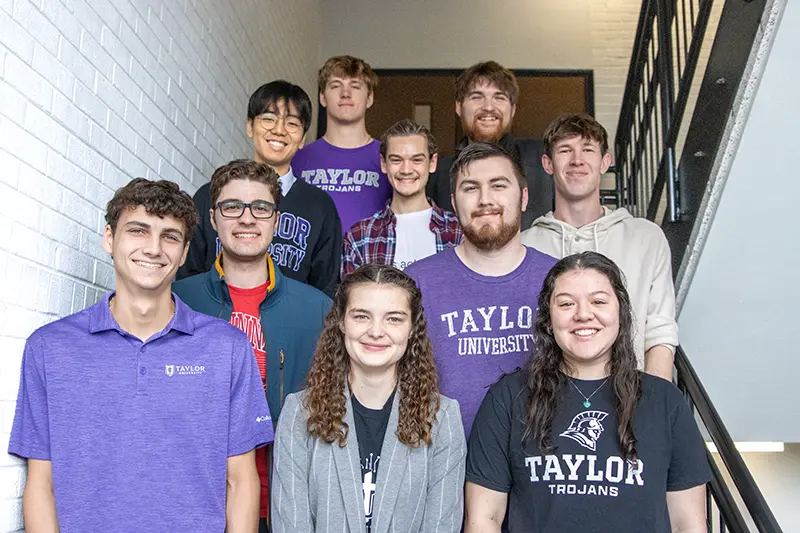
When Taylor Engineering students arrived back on campus for spring semester in 2024, they were excited to learn they would be building technology destined for space. Thanks to an innovative partnership with NearSpace Education, students began a two-year project designing and building a satellite called SkyForge CORE, transforming classroom theory into an extraordinary real-world achievement. SkyForge CORE is one of six satellites that are part of NearSpace Education’s "Dream Big" collaborative initiative.
Projects like SkyForge CORE are complex. The satellite is designed to test a radiation-resistant computer architecture that will eventually be used in building an orbital construction robot. Taylor’s participation represents far more than building hardware. It’s about equipping the next generation of engineers with the confidence, skills, and vision to tackle the world’s most pressing challenges.
A total of 12 students served as the lead technical team and were supported by an additional 50 students working on other parts of the robot. The technical team divided responsibilities across hardware design, software development, and rigorous testing protocols. They designed circuit boards, wrote software, tested components, and integrated their system into a 0.5U ThinSat, a compact satellite platform measuring just inches on a side.
Dr. Peter Staritz, Associate Professor of Physics and Engineering, noted that opportunities like Project SkyForge transform students in profound ways. "The work that students do on projects like this is the real thing. They understand that their decisions will make or break the team’s effort. As a result, they lean in and give all they have, and when they finish, they are not only much better engineers, but they have grown in confidence, wisdom, and faith."
The satellite addresses a critical challenge in space technology: radiation-induced fault tolerance in computing systems. Space is a harsh environment where radiation can disrupt computers in ways that would be catastrophic for autonomous systems. The students' work on triple modular redundancy (a technique in which three identical systems vote on decisions to catch and correct errors) could help make future space robots more reliable for construction projects in orbit, on the Moon, on Mars, or beyond.
After two years of development, the satellite is scheduled to launch in 2026 from Vandenberg Space Force Base in California aboard the SpaceX Transporter 16 mission. Taylor’s satellite will join five other student-built spacecraft orbiting Earth, each one a testament to youthful ingenuity and determination.
Matthew Voss, President of NearSpace Launch and NearSpace Education, emphasized the deeper purpose behind the initiative: "The launch project exists to help students discover their potential by turning their knowledge and skills into real-world impact."
As the launch date approaches, Taylor students are experiencing the final stages of a space mission: the anticipation, the checks and rechecks. There is also a sense of magnitude in knowing their work will soon hurtle through the atmosphere at thousands of miles per hour and settle into orbit around Earth.
For these students, the project represents more than just a capstone project or a line on a resume. It is tangible proof that their ideas matter, that their skills are real, and that they can contribute to humanity’s greatest endeavors. When the satellite deploys its solar panels and begins transmitting data back to Earth, it will carry with it not just sophisticated electronics, but the dreams, efforts, and faith of dozens of Taylor students who dared to reach for the stars. And perhaps someday, they too will return to Taylor, not as students, but as mentors guiding the next generation of engineers reaching for the stars.
The impact of SkyForge reaches far beyond one satellite. For Taylor, this partnership exemplifies the institution's commitment to combining rigorous academics with Christian values and real-world impact. The family connection between Taylor and NearSpace demonstrates how the University's influence extends beyond graduation, creating an ecosystem where alumni mentor students, resulting in faith-informed innovation.
For Indiana, the collaboration highlights the state's growing aerospace capabilities. With NearSpace Launch headquartered in Upland and staffed largely by graduates from Taylor and other in-state colleges and universities, Indiana is quietly becoming a hub for accessible space technology. The partnership keeps talented engineers in the state, strengthening Indiana’s growing aerospace workforce. Economic development that starts in the classroom and flows directly into high-tech careers.
For the nation, projects like SkyForge address a critical national need: developing the next generation of scientists and engineers who will maintain America's leadership in space exploration and technology. As space becomes increasingly important for national security, commerce, and scientific discovery, establishing a talent pipeline is essential. Programs that give students hands-on experience with real missions create the workforce that will define American competitiveness in the 21st century.
The relationship between Taylor University and NearSpace Launch runs deeper than most industry partnerships. The company's co-founders and current chief scientist and chief engineer, Dr. Hank Voss and Dr. Jeff Dailey, were longtime Taylor professors who understand the transformative power of hands-on engineering education. Today, Voss' son Matthew Voss ’06 serves as President. Many of the company’s staff once sat in the same classrooms as today’s students.
NearSpace Launch operates alongside its sister organization, NearSpace Education, a nonprofit dedicated to inspiring the next generation of STEM professionals. While NearSpace Launch provides commercial spaceflight services and satellite technology, NearSpace Education focuses on educational programs, from elementary school through college.
This dual mission—advancing commercial space technology while nurturing young talent—made the collaboration with Taylor a natural fit. It's a partnership where learning flows both ways: seasoned Taylor alumni at NearSpace Launch guiding students, while the students’ fresh perspectives push the company's innovation forward.
As their satellite circles Earth, it reflects a deeper truth that faith, learning, and bold ambition reach farther than we imagine.